The Importance of Vision
What Should a Minister Be Doing?
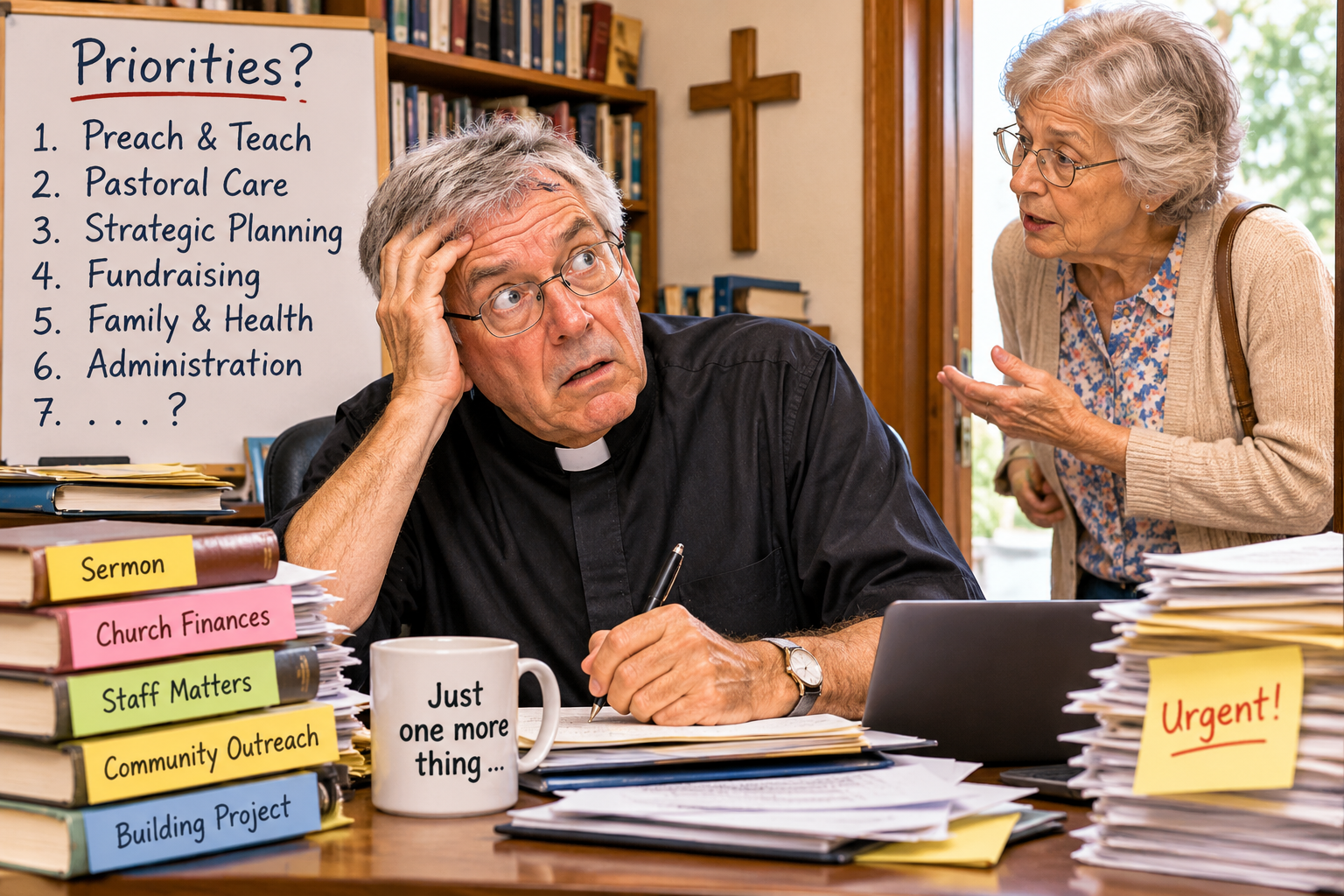
When I became a senior minister many years ago, I didn’t really have much of an idea of what I should be doing. I knew I should be preparing myself spiritually with prayer and Scripture. I also knew that I needed to preach as well as I could. There was a business meeting called a parish council to attend. I had a vague idea that the parish should be getting healthier and stronger. There was also a small staff that I was to direct, but how? Then there were parishioners who seemed to think that my time was theirs. I had to attend synod and other diocesan functions, and the local funeral directors would ring and claim my services for deceased members and for anyone who said they would be Church of England. Of course, I encouraged people to get married, and they often did. I could add much more to the list. Did I omit school scripture and parish functions? So much for the thought that clergy only worked on Sunday.
Before I arrived at my appointment, I picked up a book called Work Smarter, Not Harder, so I had some idea that I should prioritise, but it was all very vague, and I could easily be responding to whatever was the most urgent need. In fact, I even attended a seminar by an experienced minister who told us, ‘My interruptions are my ministry.’ Surely that wasn’t right, but was it? So I stumbled around, doing the best I could and hoping the parishioners would forgive my inexperience.
Someone showed me a book for business leaders that spoke of ‘working in the business’ and ‘working on the business’. That seemed to make sense, and it didn’t take the IQ of the genius Australian-born mathematician Terence Tao to see that this concept could be applied to my work. So I began to think of ‘working in the ministry’ and ‘working on the ministry’.
Working in the ministry was all the things that the average person outside the church imagines clergy spend their days doing: taking services, preparing sermons and visiting the sick and elderly. Then there are baptisms, weddings and funerals, pithily summarised as ‘Hatches, Matches and Despatches’. I have not added sweeping the church or arranging flowers, which clergy always seem to be doing, in cassocks, in television crime dramas!
I do not in any way mean to denigrate this normal ebb and flow of parish life, and I have certainly attended my fair share of working bees. But I also needed to direct my attention to the mysterious new area of working on the ministry. I boiled this down to four areas:
- Vision. The vision sets the direction of where the ministry is going.
- Money. Money funds the vision.
- Staff, whether paid or volunteer. The staff execute the vision.
- Parish council or board. They approve the vision and the funding.
To make this happen, I had to carve out time to work on the ministry by learning the skills to delegate as many of the ‘in the ministry’ tasks as I could. Naturally, some ‘in’ roles are necessary. Jesus certainly did not shun working in the ministry. But if I wanted the parish to grow and be healthy, I had to increase the time spent working on the ministry and reduce the time spent working in it.
I wasn’t too sure how to do this, but I began to diarise and protect weekly time for each of the areas of vision, money, staff and board. A friend of mine, a very competent senior minister, told me his key staff had a goal to ‘keep him out of the weeds’. This is a great thought and is true for a pastor of a church of ninety or nine hundred.
For more on these issues, see my book, Giving Generously: https://givinggenerously.com/buy-the-book-2/