
The Importance of Vision
The Good, the Bad and the Ugly
On holidays some years ago I attended a church service at a church I had never previously visited. Afterwards in the foyer I was chatting to the minister and it emerged in conversation that I was a fellow clergyman. He asked for my frank assessment of the service. ‘Tell me the good, the bad and the ugly.’ They were striking words to solicit a comment and I have never forgotten them. I believe that minister really did want some genuine feedback and it was brave of him to ask because many do not. It was also very smart because it is an excellent way to improve ministry.
In the early 1990s I did a Business degree and studied a number of marketing subjects. During that time I came across an article, Complaints as Opportunities published in the Journal of Consumer Marketing, February 1991, written by Jerry Plymire. It contained the following arresting quotation:
‘….only 4 percent of dissatisfied customers ever give us feedback about their issue. The other 96 percent vote with their feet and 91 percent will never come back.’ What is worse is that 80 percent of those dissatisfied people will pass on their negative assessment to others.. ‘Ouch!’, as an influential academic once said.
Because most people have a natural aversion to hearing complaints, a normal course of action is to try to shut down complaining behavior. Plymire advocates an opposite approach: that is to actually stimulate complaints. In other words get people to tell you the issues rather than broadcast their displeasure to the four winds.
While I am fully aware that a church is not a business and the same dynamics do not necessarily apply, a church has many of the characteristics of a not-for–profit, professional, service organization and so lessons learned in one sphere have some application to another. Armed with these thoughts I tried to encourage not whinging and whining but robust feedback, and to give it a considered hearing. Mostly the complaints were not a matter of profound theology but on irritating organization matters that could and should be remedied
One method I used was to conduct in June, an all-church survey where I would ask people to write one thing the church does well and one area we could improve. I phrased the questions in that way because I wanted to encourage a response that did not result in gratuitous carping. Further, I gave space for respondents to add their names.
I explained that I would publish the actual feedback so people could see what had been written. The exception was that I would not publish any negative personal attacks on anyone, which were negligible anyway. All went well with the first survey and the office posted the results on bulletin boards but I had forgotten to tell the office to post the comments without names which were for my eyes only. I certainly did get some real complaints and had to offer an obsequious mea culpa. The error was definitely remedied the next year.
The effect of this ongoing process was twofold. First, it helped produce a feeling of openness in the parish. People felt their concerns would get a hearing rather than be buried. Second, every year we raised money for ministry including special projects. This process gave us a clear idea of where the people felt there were areas that needed fixing.
If for example a survey showed 50 people thinking the music was too loud and 50 thought it was too soft and the rest did not mention it, I was reasonably certain that this was a non-issue. However if I received 150 responses urging me to fix the car park and fix it yesterday, then I knew this merited urgent action. My response would be to make such an item a commitment day project and when I did, it would generally be well supported.
Honestly, looking for feedback that includes the good the bad and the ugly can be a bit daunting. I remember one staff member saying that reading the regular feedback cards was like ‘pulling teeth’. Yet I do believe it is worth it. As it transpired, while there were good features to the service to which I was visitor, there was one issue that my entire family had thought of as ugly and the minister’s question provided a platform to give that feedback.
For more on raising resources for ministry see my book Giving Generously. www.givinggenerously.com




 Thanksgiving Day 2021 Sometimes ministers are cautious about asking the congregation for resources because they are worried the people will be irritated and the request will do more harm than good. I have always felt that if the request is made properly there will be excitement and joy rather than push-back. I reflected on this recently when I experienced a request for resources. A church that I know well held its annual Thanksgiving Day. This is the time of the year when the congregation is asked to fill red bags with items to be given to the homeless and the needy and to bring them to church on the day. The atmosphere was extremely positive. Why? I started to think about what it was that made me give and feel happy about doing it.
  In my book Giving Generously I recommend holding a Commitment Day when the minister asks for pledges to fund the work of church ministry for the following year. The Commitment Day is not a standalone event but the culmination of a four to six week time when the vision and ministry of the church are highlighted to the congregation. A number of activities are held in this period but the most important is the preaching series which accompanies it. It is important to note that raising resources is only a secondary purpose of the series. The primary purpose of such a commitment series is to build up the spiritual lives of the congregation and engage them in the work and vision of the church. It is for this reason it is important to hold an annual Commitment Day even if there is no pressing financial need.
 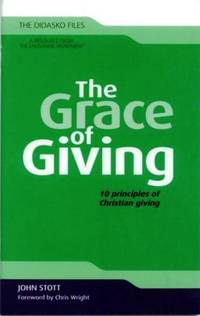 The Grace of Giving If you were asked who were the top three Christian leaders of the 20th century, who would you say? Of course the list is subjective and influenced by personal appeal and one’s own theological tradition. When I ponder that question the following names jump out to me.
  Where should I give? Several years ago the sad case of a 92 year old UK woman made the news. She had come onto the radar of a range of charitable organisations, who would ring and mail requests for donations to potential donors. I am not suggesting that there is necessarily anything wrong with this, but in the case of this lady, she was receiving so many calls and requests for money from so many different organizations that she felt completely overwhelmed. The tragic consequence was that due to these and other pressures, the poor lady took her own life.
 Landsell was born in Kent in 1841, son of a school master. He was a student at the London College of Divinity and was ordained priest in the Church of England in 1868. A teetotaller, he gained a reputation as a dynamic preacher, which he combined with a passion for missions. Obviously he was bitten with the travel bug, and not having been tied down by the incumbency of a parish, began a roving existence visiting many countries and distributing bibles and Christian literature as he did so. Initially he visited France, Germany and other western European countries but soon embarked on multiple journeys. These included Northern and Eastern Europe, and through Asia to Japan and across the Pacific to San Francisco.