
The Importance of Vision
Midyear Appeal.
A church that my wife and I attend is having its annual midyear appeal. Yes we are asked for money. If fact the congregation was asked for an eye watering amount of $1.7 million. But as far as I know people do not seem to be aggravated, offended or annoyed. In fact there is a sense of excitement and joy and positive emotion. What is going on? I have been teaching on giving and generosity for nearly twenty years. I know it is a topic that exercises the minds of most ministers on a very regular basis. However, it is also a topic that can make some church leaders very edgy. The reason is that they do not want to manipulate their congregation or they do not see how to raise resources without embarrassment or antagonism.
So why were we happy to be asked to give to this appeal?
The first reason is that we basically trust the church leadership. We have known the senior minister and many of the senior staff for many years and firmly believe they are honest people who will act honourably and responsibly. This is huge. People will not give if they do not trust those asking.
Second, the church has an excellent track record. When they have asked for money before, we are confident that it has used for the purposes stated.
Third, I am actually asked to give and give generously. There is no’ um’ ing and ‘ah’ ing around or hanging the head with a nervous embarrassment. It is clearly stated that, we are asking this year for $1-7 million dollars. Will you give generous towards the appeal? The simple fact is that if you want to raise money for ministry you have to ask and ask confidently.
Fourth, while we are asked confidently, the appeal is also transparent. We never get the feeling we are being tricked, coerced or manipulated.
Fifth, there is a spread of projects areas. All the money will go to some form of ministry to further the outreach of the church. Some will go to support the church’s very impressive overseas mission work on which we are regularly updated. Some will go help the poor and refugees in our own community. Some will go to further the church’s counselling centre ministering to the church and community. Some will go to plant more churches in a roughly half an hour radius of mother church. There is a project in there that will stir the heart of almost every one.
Sixth, the message is communicated clearly and vibrantly and passionately. There is a month of messages where the themes of the appeal are repeated. But there are also testimonies from people who have had their lives changed as a result of former appeals. Further, each week we are shown a different video highlighting work overseas or on other church campuses. These are powerful, well produced and engaging.
Seventh, the senior minister gave a lead in giving. It is a clear indication he has skin in the game as he asks us to play our part.
Finally, while most of the projects have some sort of social care element , they are all undergirded by a genuine desire to have people come to know Jesus as Lord of their lives and be transformed by His work and His love. This spiritual gospel dimension is not some sort of veneer on a social cake but informs every aspect of what the church does and what this appeal seeks to achieve.
So as we reflected on this experience this is why my wife and I are happy to give and we believe the vast majority of others feel the same. I don’t know what the results are as yet but even in challenging financial times we expect them to be good. We also expect to be asked on future occasions and we are totally fine with that.
For more on raising money for ministry, see my book Giving Generously : Resourcing Local Church Ministry. Buy The Book




 Thanksgiving Day 2021 Sometimes ministers are cautious about asking the congregation for resources because they are worried the people will be irritated and the request will do more harm than good. I have always felt that if the request is made properly there will be excitement and joy rather than push-back. I reflected on this recently when I experienced a request for resources. A church that I know well held its annual Thanksgiving Day. This is the time of the year when the congregation is asked to fill red bags with items to be given to the homeless and the needy and to bring them to church on the day. The atmosphere was extremely positive. Why? I started to think about what it was that made me give and feel happy about doing it.
  In my book Giving Generously I recommend holding a Commitment Day when the minister asks for pledges to fund the work of church ministry for the following year. The Commitment Day is not a standalone event but the culmination of a four to six week time when the vision and ministry of the church are highlighted to the congregation. A number of activities are held in this period but the most important is the preaching series which accompanies it. It is important to note that raising resources is only a secondary purpose of the series. The primary purpose of such a commitment series is to build up the spiritual lives of the congregation and engage them in the work and vision of the church. It is for this reason it is important to hold an annual Commitment Day even if there is no pressing financial need.
 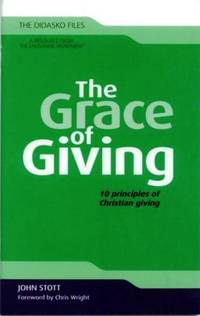 The Grace of Giving If you were asked who were the top three Christian leaders of the 20th century, who would you say? Of course the list is subjective and influenced by personal appeal and one’s own theological tradition. When I ponder that question the following names jump out to me.
  Where should I give? Several years ago the sad case of a 92 year old UK woman made the news. She had come onto the radar of a range of charitable organisations, who would ring and mail requests for donations to potential donors. I am not suggesting that there is necessarily anything wrong with this, but in the case of this lady, she was receiving so many calls and requests for money from so many different organizations that she felt completely overwhelmed. The tragic consequence was that due to these and other pressures, the poor lady took her own life.
 Landsell was born in Kent in 1841, son of a school master. He was a student at the London College of Divinity and was ordained priest in the Church of England in 1868. A teetotaller, he gained a reputation as a dynamic preacher, which he combined with a passion for missions. Obviously he was bitten with the travel bug, and not having been tied down by the incumbency of a parish, began a roving existence visiting many countries and distributing bibles and Christian literature as he did so. Initially he visited France, Germany and other western European countries but soon embarked on multiple journeys. These included Northern and Eastern Europe, and through Asia to Japan and across the Pacific to San Francisco.